Gold & Silver vs. The SpaceX IPO in 2026: Which Investment Makes More Sense?
Investing for the Future: Safety or Speculation?
The current SpaceX IPO has captured the attention of investors around the world. After all, this is the company that revolutionized rocket launches, built the Starlink satellite network, and continues to push the boundaries of technology under the leadership of Elon Musk.
At the same time, many investors are asking a different question:
Would my money be better protected in gold and silver?
Gram Spot has the answer and it depends entirely on your goals, risk tolerance, and time horizon.
If your objective is preserving wealth and protecting purchasing power, precious metals have a long history on their side. If your objective is chasing potentially massive returns, SpaceX may be worth considering. The key is understanding the risks and rewards of each.
The Case for SpaceX
There is no denying that Elon Musk has built some extraordinary companies.
Tesla is perhaps the best example.
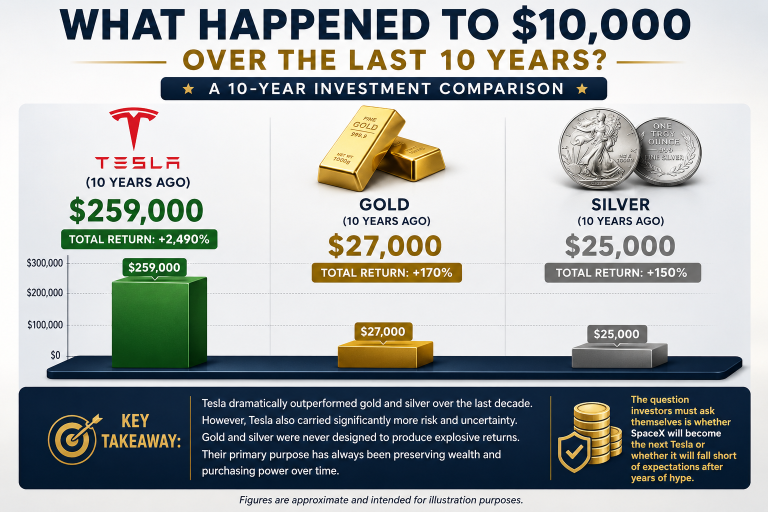
Over the last decade, Tesla has delivered a total return of approximately 2,494%, turning a $10,000 investment into roughly $259,000 before taxes and fees.
That kind of performance has created enormous wealth for early investors and has made many people wonder if SpaceX could be the next Tesla.
There are certainly reasons to be optimistic.
SpaceX dominates the commercial rocket launch industry. Starlink has become one of the fastest-growing communications businesses in the world. The company is also pursuing ambitious artificial intelligence and space infrastructure projects.
If everything goes right, SpaceX could become one of the most valuable companies on Earth.
But investors should remember something important.
Tesla’s success was never guaranteed.
Many people doubted Tesla for years. Some believed it would fail completely. Those who invested early were rewarded, but they also accepted tremendous risk along the way.
SpaceX is no different.
In fact, some analysts believe the company may be significantly overvalued at its IPO price. Morningstar recently estimated a fair value roughly 48% below its private market valuation and warned investors that the stock could face substantial volatility after the IPO.
Could SpaceX become the next trillion-dollar success story?
Absolutely.
Could it become one of the most disappointing investments of the decade?
That is also possible.
The Case for Gold and Silver
Gold and silver are very different investments.
Unlike SpaceX, precious metals do not rely on management decisions, product launches, earnings reports, or technological breakthroughs.
Gold has been used as a store of value for thousands of years. Empires have risen and fallen. Currencies have come and gone. Gold has remained.
Silver has a similar history while also benefiting from industrial demand in areas such as electronics, solar energy, and manufacturing.
Today, gold trades around $4,100 to $4,300 per ounce, while silver trades around $62 to $70 per ounce.
Over the past decade, both metals have appreciated significantly while helping investors hedge against inflation, currency devaluation, and economic uncertainty.
The biggest advantage of gold and silver is not that they make people rich overnight.
The advantage is that they help people stay rich.
They are designed to preserve purchasing power over long periods of time.
Gold and silver may never produce Tesla-like returns, but they have survived every financial crisis, war, recession, and currency experiment in modern history.
Don’t Bet Money You Can’t Afford to Lose
One of the most important investing principles is surprisingly simple:
Never invest money you cannot afford to lose. As the great investor Warren Buffet says, “Rule Number One is Never Lose Money”
This is especially true when investing in speculative opportunities such as IPOs.
Many investors get caught up in excitement and headlines. They see stories of overnight millionaires and assume every hot stock will follow the same path.
History shows that most do not.
While SpaceX has tremendous potential, there are still many unknowns surrounding its future growth, valuation, competition, and execution.
Gold and silver carry risks as well, but they generally do not face the same business risks as an individual company.
A Balanced Approach
For conservative investors, the smartest strategy may not be choosing one investment over the other.
It may be owning both.
For example, someone investing $10,000 might consider allocating:
-
70% to 90% in gold and silver
-
10% to 30% in growth investments such as SpaceX
Some investors may choose an even smaller allocation to SpaceX, perhaps 5% to 10%.
This approach offers several advantages.
If SpaceX becomes the next Tesla, you still participate in the upside.
If SpaceX struggles or falls dramatically after the IPO, the majority of your wealth remains protected in assets that have historically preserved value.
Final Thoughts
SpaceX could become one of the greatest investments of our generation.
It could also disappoint investors who buy at inflated valuations.
Nobody knows for certain.
Gold and silver are different. They are not exciting. They do not make headlines every day. But they have quietly preserved wealth for thousands of years.
For many investors, the best answer is not choosing between precious metals and SpaceX.
It is recognizing the role each plays in a portfolio.
Invest in gold and silver as your foundation.
Use speculative investments like SpaceX as the upside opportunity.
That way, if SpaceX changes the world, you participate.
And if it doesn’t, your financial future is not riding on a single bet.